School of Communication Sciences and Disorders
Communication, Camaraderie, and Confidence: Aphasia Boot Camp
Each June for the last seven years, the Memphis Speech and Hearing Center (MSHC) transforms into a powerful space for growth, healing, and connection through Aphasia Boot Camp, an intensive, person-centered therapy program for adults living with aphasia.
“Aphasia Boot Camp is about more than therapy. It’s about helping people reconnect with their lives,” said Springs. “You see real change over the course of the month, not just in speech and language skills, but in confidence and connection.”
The Boot Camp has become one of MSHC’s most impactful and enduring clinical experiences. Designed for individuals who have experienced strokes, traumatic brain injuries, or progressive neurological conditions resulting in aphasia, the intensive program runs for four weeks, Monday through Friday, from 9 a.m. to noon. Participants engage in a blend of individual and group therapy sessions, receiving personalized support while building a sense of community.
What made Aphasia Boot Camp 2025 especially unique was its regional reach. Clients traveled from six different states to participate: Tennessee, Mississippi, Missouri, Oklahoma, Louisiana, and Ohio. Many relocated to Memphis temporarily, staying in hotels or short-term rentals, demonstrating extraordinary commitment to their rehabilitation journey. “Their decision to travel and relocate to an unfamiliar city showed their determination and grit,” said Ballinger. “We were honored to be a part of their journey.”
The diversity among participants this year reflected the wide-reaching nature of aphasia. Clients’ ages ranged from 30s to 80s, and backgrounds included entrepreneurs, professionals with advanced degrees, and individuals navigating very different stages of recovery. Some were relearning their children’s names, while others were preparing to reenter the workforce.
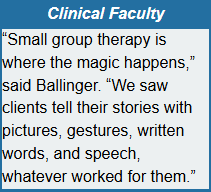
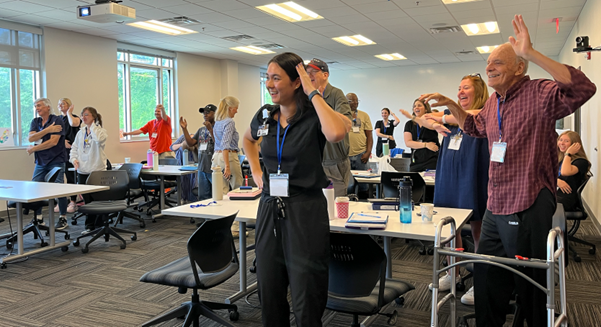
Each day was filled with purposeful activities designed to treat aphasia and cognitive-communication challenges, and to restore a sense of agency, connection, and identity for participants. Among the most powerful components of the program were the small conversation groups, which created meaningful opportunities for shared communication. Given the often isolating nature of aphasia, these group sessions reminded participants that they are not alone in their experiences. Clients discovered a safe, supportive space where they could take their time to communicate, and where everyone, clients and student clinicians alike, listened with patience, curiosity, and respect. This kind of environment is especially meaningful for individuals who are often misunderstood, overlooked, or marginalized. Ballinger noted that, “The room was filled with support, laughter, and celebration. The students and I got front row seats to watch camaraderie and confidence take root and grow.”
Springs echoed that sentiment, reflecting on how the camp’s immersive structure helps graduate students connect with participants as whole people with families, friends, hopes, and dreams. “We talk a lot about evidence-based practice and data collection, but what really makes a difference for a successful clinician is building relationships and connecting with the person next to you. The immersive nature of Boot Camp makes it quite impossible to miss that lesson.”
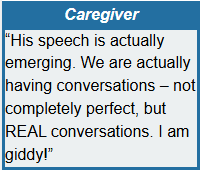 One of the most heartening aspects of the 2025 Boot Camp was the connection built
within the entire community of participants and their support networks. Springs said,
"It was heartwarming to watch clients and caregivers reach out to others; to see the
hugs, the laughter, and the way everyone’s personalities blossomed over the course
of the month.” Clients and caregivers alike formed meaningful relationships, offering
encouragement, exchanging contact information, and even requesting an Aphasia Boot
Camp "yearbook” to commemorate the experience. Caregivers shared heartfelt reflections
on the impact of the camp: "The whole team of people who worked very hard for the
clients deserve a big thank you,” one caregiver shared. Another volunteered that “They
touched our hearts from Day 1. Anyone who participated in this warm atmosphere would
have seen improvements in the end."
One of the most heartening aspects of the 2025 Boot Camp was the connection built
within the entire community of participants and their support networks. Springs said,
"It was heartwarming to watch clients and caregivers reach out to others; to see the
hugs, the laughter, and the way everyone’s personalities blossomed over the course
of the month.” Clients and caregivers alike formed meaningful relationships, offering
encouragement, exchanging contact information, and even requesting an Aphasia Boot
Camp "yearbook” to commemorate the experience. Caregivers shared heartfelt reflections
on the impact of the camp: "The whole team of people who worked very hard for the
clients deserve a big thank you,” one caregiver shared. Another volunteered that “They
touched our hearts from Day 1. Anyone who participated in this warm atmosphere would
have seen improvements in the end."
 This year’s program reaffirmed what clinicians have known all along: aphasia therapy
is not just about words, it’s about rebuilding lives. The students who participate
gain invaluable clinical experience, but more importantly, they witness the power
of compassion, persistence, and human connection. Student clinician, Emily Johnson, reflected,
“Aphasia Bootcamp not only changes the lives of people with aphasia, but also the
student clinicians. It was an honor to witness the gains each client made this year!
This experience furthered my excitement to be a SLP, and I am extremely grateful to
have been a part of it.”
This year’s program reaffirmed what clinicians have known all along: aphasia therapy
is not just about words, it’s about rebuilding lives. The students who participate
gain invaluable clinical experience, but more importantly, they witness the power
of compassion, persistence, and human connection. Student clinician, Emily Johnson, reflected,
“Aphasia Bootcamp not only changes the lives of people with aphasia, but also the
student clinicians. It was an honor to witness the gains each client made this year!
This experience furthered my excitement to be a SLP, and I am extremely grateful to
have been a part of it.”
Ultimately, Aphasia Boot Camp continues to be a flagship experience at the Memphis Speech and Hearing Center, helping individuals with aphasia rediscover their voices, reconnect with their communities, and reclaim their stories.
Aphasia Bootcamp 2025: Program Team
| Clincal Faulty/Supervisors | Students | |
|
Tawni Ballinger (founder/ 2025 leader) Justine Springs (2025 leader) Caroline Royal-Evans Cille Heehs Julie Marshall Kelli Owens (founder) Name Name Name Name Name
|
Gabriel Rowin Clara Bednarek Abby Shainberg Alexa Cortez Sophie Blatt Rachel Schwantes-Barreto Ambria Murphy Lacey Halley Miranda Fritz Elizabeth Wardlow Eve Knight Molli Fee |
Megan Simmons Lillian Neal Sophie Borhi Isabella Montecillo Emily Johnson Laurel Hansen Albreia Etienne Christine Mahoney Hannah Dugan Allison Donahue Emily Witt Nathalie-Khue Trinh |