
About the Fayette County Movement
"I learned to stand up for what is right for people. And what is right for minority people is right for non-minority people." — Viola McFerren, Fayette County Activist
Mary Williams Talks about Registering to Vote and Eviction in Fayette County, Tennessee
Why is Tent City important as a Civil Rights Era Event?
The Tent City movement in Fayette County is significant for a number of reasons.
First, it was a truly grassroots movement-initiated, organized, and maintained by Black residents in the local community. Outside help from regional sympathizers, college activists, and the federal government certainly came in and helped the Fayette County participants to keep the movement going, but the leaders and long-term participants were locals.
Second, unlike many more widely known civil rights events, Tent City was a rural movement whose participants made their living from the land-most of the African American population worked for white landowners as sharecroppers. This meant the civil rights movement in Fayette County was primarily an effort of the poor. This can be better appreciated if we note that the middle-class, more educated African Americans, who had more resources to start a movement, were few and mostly found in urban areas. At the time, most African Americans in the rural South were poor and under-educated and, therefore, many of the movements during the Civil Rights Era were initiated by white sympathizers who came to the South to recruit and organize black activists.
Finally, Fayette County, as well as adjacent Haywood County, was politically promising because they were the only two of 96 Tennessee counties in which African Americans outnumbered white residents. This made political change at a significant scale possible if Black citizens could vote. Also, being located in the southwestern part of the state and adjacent to the Mississippi state line, Fayette County was in a strategic position for extending efforts into Mississippi, which had garnered much of the national attention concerning civil rights violations and violence.
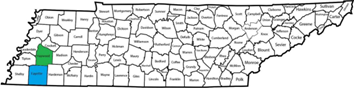
Map of Tennessee highlighting Fayette (blue) and Haywood (green) counties.
Image adapted from work by JusBer 88 on Wikimedia.
No website can do justice to the nuanced historical, social, political and personal factors forming the perfect storm that hit Fayette County, Tennessee, in the summer of 1959. From this maelstrom, African American residents were among the first in the rural South to begin their struggle for civil rights. Although major progress was made during the modern civil rights era, the struggle for equality continues today. While many people collectively worked for social justice in Fayette County, it is impossible to individually acknowledge all who risked their lives, livelihoods, and homes to break out of the second-class roles they were forced into from the days of slavery. Although some people involved in the national Civil Rights Movement attained high public profiles, becoming recognized icons for change, most would acknowledge that the strengths they may have wielded were founded upon the collective efforts of many unnamed individuals whose contributions may never be known. As with other movements, this holds true for the efforts in Fayette County.
Though we cannot begin to tell (or even find) every individual's story from this era, we want to include as broad a variety of perspectives as possible; this site provides a venue in which Fayette County residents and other participants in the movement can describe their experiences of these events. But we are also interested in the relationship between history and the present.
How do experiences from the 1950s, 6os, and 70s affect people's feelings, hopes, or concerns about Fayette County today? What do these stories mean to young people who are just learning about the county's past?
Why is Tent City important to know about now and into the future?
We believe the stories and discussions gathered here may have meaning to people far beyond Fayette County. The struggle for justice is not unique to this region and here, as elsewhere, it highlighted deep divisions within the community while forcing everyone who lived in the area to think about what change might mean for their society and for themselves as individuals. We want to understand how people live and work in a shared locale during periods of social upheaval, or how they negotiate contemporary conflict while planning for a still uncertain future.
Today, Fayette County faces new kinds of change, including the impact of growth from nearby Memphis. What does Fayette County's history mean to newer residents-whether they have moved there recently or are young people born locally-and how might broader recognition of that past shape the county today?
We think the stories of Fayette County offer a special opportunity to understand how communities can overcome difficult pasts and remind us that these human rights issues continue and remain urgent in national and global discussions.
Minnie Jameson on Getting Started and Making a Difference