
School of Public Health
Faculty Spotlight - Dr. Meredith Ray

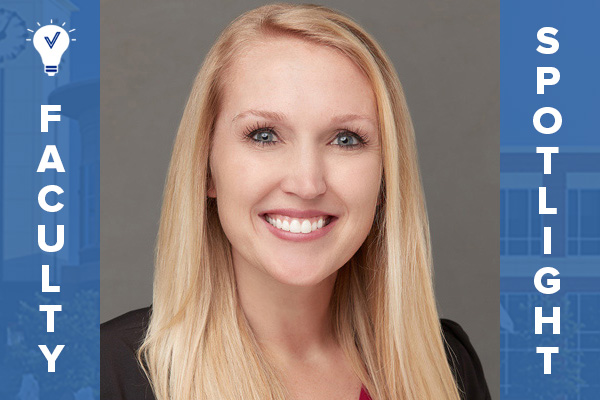
Q&A with Dr. Meredith Ray, PhD
Program Coordinator, Associate Professor
- What is the broad focus of your research?
As a biostatistician, my role is two-fold. Part of my research focuses on novel statistical methodology and the other is statistical applications with collaborators. My methodology primarily focuses on clustering with an emphasis on high-dimensional data or survey grouped data. My application fields are predominantly in lung cancer, sickle cell, and HIV. - What inspired you to pursue this particular area of research?
I have always enjoyed solving puzzles and finding patterns, so my interest in clustering was a natural extension. - What is the most exciting project you are currently working on?
I’m looking forward to working with my graduate level student on various extensions to our clustering algorithm, termed Vector in Partition or VIP. The original VIP clusters genetic and epi-genetic data but look to extend this to cluster genetic and longitudinal epi-genetic data. - How does your research impact or benefit the broader community or public health field?
And how do you envision your research evolving in the next few years?
While novel statistical methodology is needed across all fields, the statistical applications in lung cancer, sickle cell, and HIV have more pervasive outcomes and notable impacts. In lung cancer for example, our work and database has helped lead to changes in surgical resection guidelines, staging guidelines, and pathologic gross dissection techniques, all of which improve patient treatment and thus survival. These impacts are not only here in the Memphis area but across the globe. I hope to continue my work in these fields and further merge my statistical methodologies with the areas of interest. - What is the coolest training or program you've been a part of, or your favorite conference
you've attended?
My favorite conference to attend every year is the World Conference on Lung Cancer. It’s the largest lung cancer focused conference with thousands of participants. Due to its size and impact, you truly get to see the collaboration impact of nurse navigators, nurses, surgeons, oncologist, hematologist, pathologist, radiologist, epidemiologist, biostatisticians, etc. - What is your favorite self-authored manuscript?
My favorite self-authored paper is “Identifying Activation Centers with Spatial Cox Point Process Using fMRI Data” (Ray et al. 2015). This work was part of my dissertation where we employed a spatial Cox Point Process to cluster fMRI meta brain data. Because of the nature of the data, we were clustering 3D spatial data and needed to account for study effects given the nature of data collection. This was one of my first statistical methods papers and still proud of our work. - What kind of research would you like to be doing that you haven't yet had the opportunity
to do?
I would eventually like to tie my two interests of clustering and lung cancer genetics/epigenetics together. We currently do not capture this information in our lung cancer work but are consistently looking into the future with AI and driving biological impacts like genetics/epigenetics that might be drivers of lung cancer.