
Graduate School
Samantha Guajardo - Using Rhetoric to Uplift Voices and Challenge Boundaries
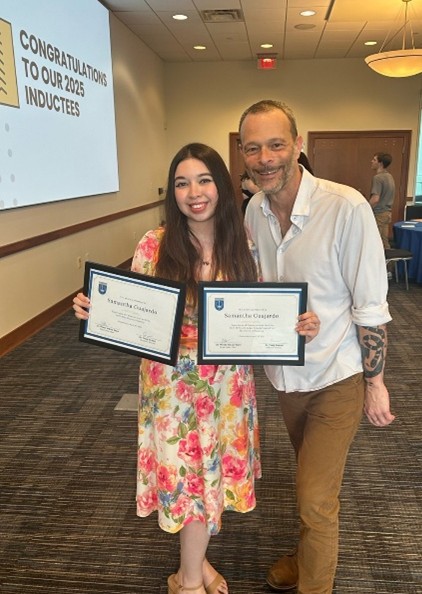 For Samantha Guajardo, pursuing a Ph.D. in Communication and Film with a concentration in Rhetoric and Media at the University of Memphis is more than an academic pursuit—it’s a continuation
of a lifelong commitment to understanding identity, power, and voice.
For Samantha Guajardo, pursuing a Ph.D. in Communication and Film with a concentration in Rhetoric and Media at the University of Memphis is more than an academic pursuit—it’s a continuation
of a lifelong commitment to understanding identity, power, and voice.
Growing up in the Rio Grande Valley, Texas, Samantha saw rhetoric at work in her community long before she studied it formally. In a region often misrepresented by national media, she watched Latina leaders use storytelling, organizing, and advocacy to reshape the narrative—responding to stereotypes with care, resistance, and truth.
“Rhetoric became the bridge between English and Communication for me,” Samantha shares. “It’s a field that doesn’t just study discourse—it asks critical questions about who is heard and who is silenced.”
Her extensive academic journey laid the foundation for her Ph.D. research, which explores Latina rhetorical agency and challenges academic boundaries around what counts as rhetoric and who counts as a rhetor.
Recognizing Excellence in Scholarship and Teaching
Samantha’s work and dedication have not gone unnoticed. She is the recipient of both the Osborn Fellowship and the John Angus Campbell Teaching Award—two honors that represent the heart of her dual passions: research and teaching.
“The Osborn Fellowship affirms the direction of my research, particularly my commitment to studying Latina rhetorical agency,” she explains. “And the John Angus Campbell Teaching Award holds a special place in my heart. Teaching has always been more than a professional obligation—it’s a space of mutual learning and growth.”
At UofM, Samantha teaches courses in public speaking, rhetoric, and interpersonal communication. She designs her classes to center reflection, application, and experiential learning, helping students connect theory with their lived experiences. One of her favorite assignments, the Student Philosophy Speech, invites students to articulate their goals and explore how communication supports personal growth.
“Watching students gain confidence in expressing their ideas is one of the most rewarding parts of my work,” she says.
Teaching Philosophy and Student Impact
Samantha’s teaching philosophy is grounded in the belief that education is a collaborative and transformative process. Drawing inspiration from scholars like bell hooks and Paulo Freire, she strives to create spaces where students feel seen, heard, and empowered to advocate for themselves and their communities.
Her work with Writing and Communication Services (WCS) at UofM is another extension of this philosophy. As a facilitator for Tigers Talk and a trainer for Tigers Tank, Samantha supports multilingual students in developing their public speaking and presentation skills.
“Watching students grow into their voices—seeing that moment when confidence unfolds—is always moving,” she says. “It’s why I do this work.”
Community, Commitment, and Motivation
Throughout her doctoral journey, Samantha has found strength in community and mentorship. She credits her advisor, Dr. Antonio de Velasco, for his guidance and her family—her parents, brother Zach, grandparents, Aunt Kim, and fiancé Anthony—for their unwavering support.
“Academia can be demanding, but it feels far more manageable when you’re surrounded by people who care about you,” she reflects.
For Samantha, staying grounded means staying connected—to people, purpose, and perspective. She reminds herself daily of the significance of representation:
“Latinas make up around one percent of doctorate holders, and that statistic weighs heavily on me—not as a burden, but as a reminder of why this work matters. It’s about helping make space for those who come next.”
Looking Ahead
After completing her Ph.D., Samantha hopes to continue her career in higher education—teaching, mentoring, and conducting research that centers Latina activism and rhetorical agency in border spaces. Her goal is to develop historically grounded accounts of Latina rhetors and the sociopolitical conditions that shape their public engagement.
When she’s not researching or teaching, you can often find her in a Memphis coffee shop—French Truck or Belltower are her favorites—recharging over a matcha latte and good conversation.
“It’s a simple ritual, but it helps me remember the joy that exists outside of academia.”