
This is an innovative initiative aimed to assist youth to come up with out-of-box
solutions to address public health challenges of the 21st century. This platform brings
together youth's ideas on how today's pressing public health problems can be addressed
across diverse local and global settings.
We bring together some selected high schools in this inaugural launch - before we
embark upon the journey to solving public health challenges by connecting youth locally,
nationally, and globally.
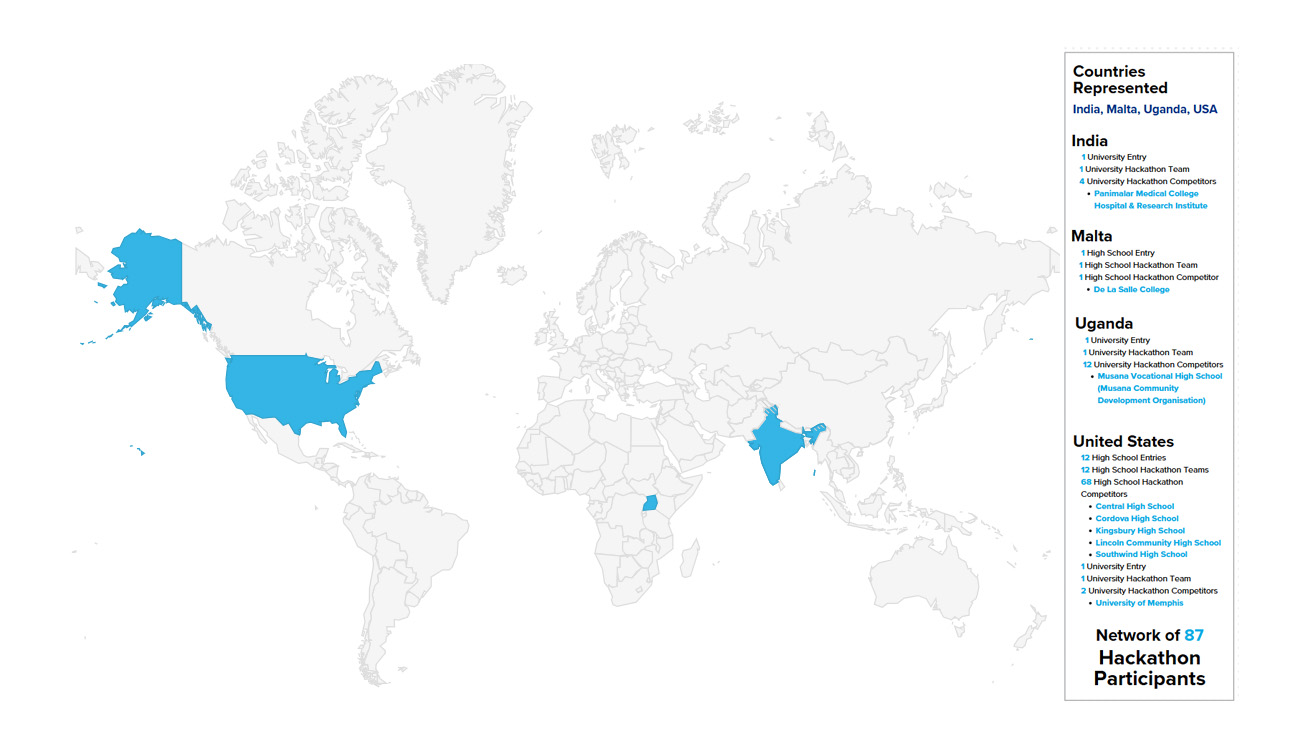
87 Students Participating in Hackathon 16 Teams Entered for Competition 6 High Schools
Represented 3 Colleges Represented 4 Countries Involved
Are you ready to turn ideas into reality? The hackathon teaches you the skills to
think about solving public health problems, not just identifying them. Through workshops
you can get expert feedback on your innovative and sustainable solutions--that you
can take back to your community to spark improvement of good health and well-being.
Become a champion of public health change!
VIDEO
Frequently Asked Questions
For more information click a drop-down arrow below
Criteria ↓
Abstract Details (Limit: 500 words)
Problem statement (10 points) highlights the topic and the public health problem it
addresses.
Background
Objective
Significance and Relevance
Solution/Innovation proposed (10 points)
Approach - describe how you plan to address this problem (10 points)
Impact: How would you assess? (10 Points)
Sustainability: How will you propose the sustainability of the solution? (10 Points)
Pitch
To participate, submit a 1-3 minute YouTube video pitch by April 1, 11:59 PM CST,
following these guidelines:
Upload your recorded video to YouTube as an unlisted link.
Address key evaluation criteria
Submit your YouTube video link through the pitch submission form emailed to participants
Judging Criteria
The best public health ideas will be selected by the esteemed jury representing a
multidisciplinary team based on the following criteria:
Creative
Research-oriented
Entrepreneurial
Accessible
Transformative
Effective
Timeline ↓
The hackathon competition spans 9 months.
Fall
Hackathon Announcement
Winter
Registration, Workshops, Submissions and Pitching
Spring
Winner Announcement
Awards ↓
Awards and Recognition
Certificate of Participation
School of Public Health Swag
Gift vouchers
The best public health ideas will get an opportunity to be featured on our official
SPH website, social media, and newsletter.
Competition ↓
Why should I participate in the hackathon?
Learn to turn ideas into reality! The hackathon teaches you the skills to think about
solving public health problems, not just identifying them. Through workshops you can
get expert feedback on your innovative and sustainable solutions--that you can take
back to your community to spark improvement of good health and well-being. Become
a champion of public health change!
Who can participate?
High school students from grades 9-12 and undergraduate university students.
What is a public health issue?
Public Health issues include diseases and conditions that impact entire populations.
A few examples include: how to tackle obesity, ways to enhance physical activity,
mental health issues among youth, environmental and climate health concerns, risky
behaviors (such as drug, alcohol, and substance abuse), access to healthy food, social
media misinformation, and ways to address violence and bullying.
Santi Indra Astuti
Faculty of Communication Science, Journalism Dept., Islamic University of Bandung
(UNISBA), Indonesia
Dr. Neville Calleja
A Full Professor and Head of Department for Public Health, Faculty of Medicine & Surgery
of the University of Malta , Malta
Rafaela Rosário
Assistant professor at the University of Minho, School of Nursing, Campus of Gualtar,
Portugal
Dr. Becky White
Adjunct Research Fellow at Curtin University, a director at Reach Health Promotion
Innovations, a Digital Health Advisor to the Australian Digital Health Agency, Australia
Cherstyn Hurley
Immunisation publications manager and infodemiologist, Immunisation and Vaccine Preventable
Diseases Division, UK Health Security Agency, United Kingdom
Dr. Timothy Mackey
Director, Global Health Policy and Data Institute, UC San Diego, United States
Dr. Laura Magaña
President and CEO of the Association of Schools and Programs of Public Health (ASPPH),
Founding President of the Global Network for Academic Public Health (GNAPH), United
States
Dr. Catherine Bertrand-Ferrandis
Director Strategic Communication, France
Renata Mares
Renata E. Mares MIPH, BSN, BAKin, WHO IM, Founder & CEO, Adaptation Consultant, Public
Health, Canada
Dr. Chris Voegeli
Behavioral Scientist, Acting Inaccurate Health Information Mitigation Team Lead, Division
for Communication Science and Services, Office of Communications, CDC, United States