
CAESER tests fault zone water while drilling for answers on Memphis Aquifer
February 25, 2026
All across the Mid-South, and in West Tennessee in particular, members of the Center for Applied Earth Science and Engineering Research (CAESER) are literally digging for answers to better understand one of our most vital resources.
CEASER launched a massive effort to study the Memphis aquifer and the water we use daily to drink, brush our teeth and bathe. Nearly 20 different projects contribute to that research of Memphis’ water, a substance many people in the Mid-South brag about but few, including those examining it, fully understand. The project is sponsored by Memphis, Light, Gas, and Water and the City of Memphis, whose support makes this vital research possible.
“This kind of presented a new challenge that was relatively unexplored. We don’t know a ton about it and especially in Memphis, it’s just kind of a gap. That’s a lot of what PhD dissertation work is: filling in gaps in knowledge. So, I was really excited to be a part of that project of getting to understand something that we don’t quite know,” said Brooke Lafferty, a PhD student in the Herff College of Engineering and member of CAESER.
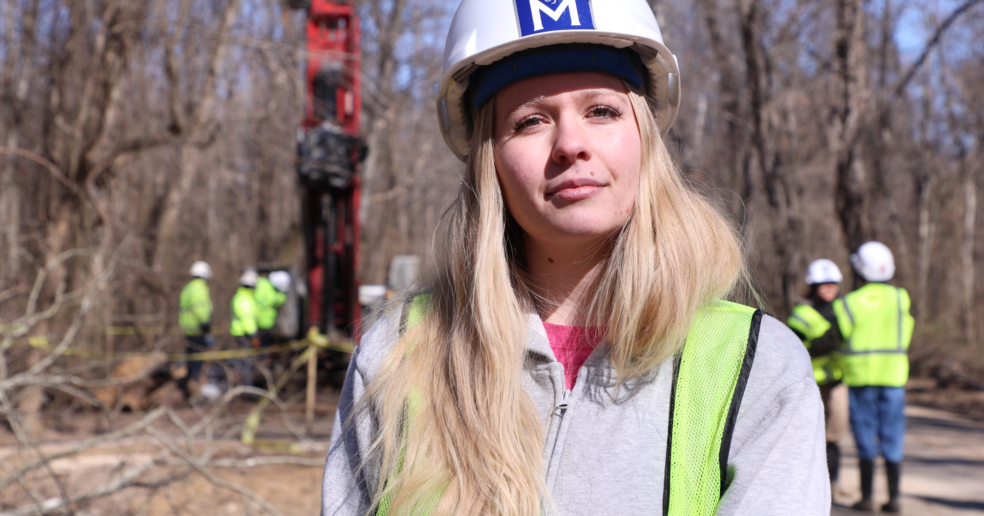
Lafferty’s piece of CAESER’s aquifer puzzle concerns what, if any, impact fault zones have on groundwater. On a bitterly cold February morning in Shelby Forest, Lafferty and her team looked on as a drill hammered its way into the soil. It stopped every 10 feet to take samples, samples that other CAESER researchers will study in their own projects. But Lafferty’s prize awaits 300 feet below the surface. That’s where she will take her first water sample from an area known to be outside of a fault zone.
Lafferty’s team will drill again, further down that dirt road in Shelby Forest, where a fault zone lies, along with an unknown variable.
“This will serve largely as a baseline for what fault zones look like… We don’t know what the water quality of a fault zone looks like. So, it’s important to test the water in a fault zone so we can compare. Does this look similar to what we’re seeing here?” Lafferty said.
Lafferty plans on taking water from the fault zone and comparing it with the water sample taken from outside the fault zone. That comparison could answer two important questions: does the fault zone serve as a barrier to the water supply and does the fault zone allow for vertical movement into the water supply?
The water flowing horizontally beneath our feet is thousands of years old. If the fault zone serves as a barrier, it could be protecting our drinking water from sources like the Mississippi River. But if the fault zone, through shifting in the earth’s surface, allows for a vertical pathway of water, that could mean that “new” water, including any possible contaminants, may be seeping into our crucial, ancient supply.
“If we see similarities to, say, the Mississippi River water or the shallow aquifer water, that may be an indication that the faults are acting as some kind of pathway for water to move,” Lafferty said.
But before we know the effect of the fault zone, Lafferty said we first have to understand how the water moves into it.
“We’re not necessarily looking at whether a fault zone is going to contaminate our water. It’s more of, ‘How is it influencing our water?’ And we just want to understand that better… If we know how fault zones are affecting our water, we want to know, ‘Is there a contamination source near it? Is it going to contribute?’ We’re just looking at specific chemical footprints to distinguish the water. What does fault zone water look like?” Lafferty explained. “If we see differences in water quality in the undeformed well from the deformed, faulted well, that tells us that fault zones are affecting our water. We want to know that because this is not just the one fault zone we have in Shelby County and Memphis. There are a couple. So, we want to see if they are having an effect at all.”
And just as the fault zones are spread out across West Tennessee, so are CAESER’s researchers.
“Where I grew up in Middle Tennessee, we didn’t have this kind of program,” Lafferty said. “I was really excited to be a part of it. It’s very interesting. We have a big collective of graduate students and we get to do really cool research… It’s just a big support group. We get to all support each other and we not only get to work on our own projects, but we also, just to get experience, we get to work on other people’s projects as well and just assist with research and fieldwork. I’ve learned so much. It’s been a really great opportunity, honestly.”
When Lafferty’s research is combined with the information gathered from dozens of her colleagues, CAESER hopes to have a better understanding of the Memphis aquifer and an in-depth study that could serve to protect it and benefit future generations.
“A better understanding of our aquifer system is really important to understanding how to manage it,” Lafferty said. “If there are factors that are affecting groundwater quality or storage in the aquifer, I think it’s best to have a deep understanding of it to ensure that, in the future, we have that same resource.”